

Introduction
This guide is designed for IT professionals, website owners, and network administrators seeking to understand and implement effective DDoS blocking strategies to protect their online assets. DDoS attacks can disrupt business operations, cause downtime, and damage reputations, making robust protection essential for anyone responsible for maintaining online services and infrastructure.
We cover the fundamentals of DDoS attacks, blocking techniques, best practices, and leading service providers to help you build a robust defense. By following this guide, you will gain practical insights into identifying, preventing, and mitigating DDoS threats to ensure business continuity and data security.
Key Takeaways
- DDoS blocking involves filtering malicious traffic while allowing legitimate users to access services and applications.
- Anti DDoS solutions combine hardware and software protection to safeguard websites, networks, and IT infrastructure from DDoS attacks.
- Effective DDoS protection requires multiple layers including rate limiting, traffic filtering, and cloud-based mitigation services.
- Modern DDoS attacks can exceed 449 Tbps in scale, requiring specialized infrastructure and global networks for effective blocking.
- Real-time monitoring and automated response systems can mitigate DDoS attacks in under 3 seconds.
- Combining network-level, protocol-level, and application-level protection provides comprehensive DDoS mitigation capabilities, and helps prevent attacks by analyzing traffic patterns and emerging threats.
What is DDoS Blocking?
DDoS blocking is the process of filtering and stopping malicious internet traffic before it reaches your target servers. When a bad actor launches DDoS attacks, they overwhelm your infrastructure with excessive traffic from multiple sources, disrupting normal business operations and preventing legitimate users from accessing your services.
The key difference between legitimate traffic spikes and coordinated attacks lies in the traffic patterns. Normal activity refers to typical network traffic patterns that serve as a baseline for detecting anomalies. Normal traffic increases gradually during peak usage periods, while DDoS attacks create sudden, massive surges of illegitimate requests from distributed botnets and infected devices. These attacks aim to exhaust your server resources, consume bandwidth, and crash systems through various techniques including flood attacks and protocol exploitation.
Effective DDoS protection ensures business continuity by maintaining service availability for legitimate traffic while automatically identifying and blocking attack traffic. This protection becomes critical when considering that modern attacks can generate traffic volumes exceeding several terabits per second, far beyond what traditional firewalls or single servers can handle.

How DDoS Blocking Works
DDoS blocking operates through sophisticated traffic analysis and pattern recognition systems that identify malicious requests from normal user activity. These systems perform real-time packet inspection, analyzing data packet characteristics, source IP addresses, request frequencies, and behavioral patterns to distinguish between legitimate users and coordinated attack sources.
Core Blocking Mechanisms
- Rate limiting and traffic shaping: Control incoming connection volumes by setting thresholds for requests per second, connections per IP address, and bandwidth consumption.
- Automatic mitigation: When traffic exceeds established baselines, the system automatically triggers mitigation techniques to prevent resource exhaustion.
Global Scrubbing Centers
- Traffic redirection: Uses BGP routing to redirect suspicious traffic through filtering networks with massive capacity—often exceeding 5 Tbps—where malicious packets are identified and dropped while clean traffic continues to your servers.
- Cloud migration: Organizations migrating to the cloud can leverage increased bandwidth and integrated mitigation tools to better mitigate attacks.
Typical DDoS Blocking Process
- Packet inspection → Pattern detection → Risk scoring
- Rate limiting → Geo-blocking → Protocol validation
- Application analysis → Bot detection → Content filtering
- Clean traffic delivery → Performance monitoring
Continuous Monitoring
- Advanced solutions integrate global threat intelligence and machine learning algorithms to identify new attack vectors and automatically update filtering rules without human intervention.
Types of DDoS Attacks to Block
Volumetric Attacks
Volumetric attacks represent the most common form of distributed denial of service attacks, designed to consume all available bandwidth on target servers. These attacks, typically categorized as Layer 3 and 4 assaults, send massive volumes of forged packets through UDP floods, ICMP floods, and DNS amplification techniques.
How Volumetric Attacks Work
- UDP floods: Overwhelm target systems by sending large volumes of packets to random ports, forcing servers to check for applications and respond with destination unreachable packets.
- Bandwidth exhaustion: This process exhausts both bandwidth and processing resources, effectively creating denial of service DDoS conditions for legitimate traffic.
Protection Strategies
- Content delivery networks (CDNs): Provide effective protection against volumetric attacks through bandwidth scaling and traffic distribution.
- Global networks: CDN providers maintain global networks with sufficient capacity to absorb massive attack volumes while delivering normal content from edge locations closest to users.
Example: Volumetric Attack Detection Thresholds
Volumetric attack detection thresholds
Normal baseline: 50 Mbps average traffic Attack threshold: >500 Mbps sustained for >30 seconds Mitigation trigger: Automatic redirection to scrubbing centers
Protocol Attacks
Protocol attacks exploit weaknesses in network protocols, particularly targeting TCP/IP connection processes through SYN floods and other state-exhaustion techniques. These attacks consume server resources by initiating thousands of incomplete connections, preventing legitimate users from establishing new sessions.
How Protocol Attacks Work
- SYN flood attacks: Target the TCP three-way handshake process by sending numerous SYN requests without completing the connection establishment.
- Resource exhaustion: Forces target servers to maintain connection state information until timeouts occur, quickly exhausting available connection tables and memory resources.
Protection Strategies
- Next-generation firewalls and intrusion prevention systems: Provide protocol-level filtering to identify abnormal connection behavior.
- Web application firewalls: Analyze protocol compliance and block requests that violate standard communication patterns.
Application Layer Attacks
Application layer attacks represent the most sophisticated form of DDoS activity, designed to mimic legitimate traffic while consuming backend server resources through targeted requests. These Layer 7 attacks often prove more effective than volumetric approaches because they require significantly less bandwidth while targeting specific application vulnerabilities.
How Application Layer Attacks Work
- HTTP floods: Send legitimate-looking requests to resource-intensive pages or functions.
- Targeted resource exhaustion: Attackers focus on database queries, search functions, or file upload processes that consume significant processing power and memory resources per request.
Protection Strategies
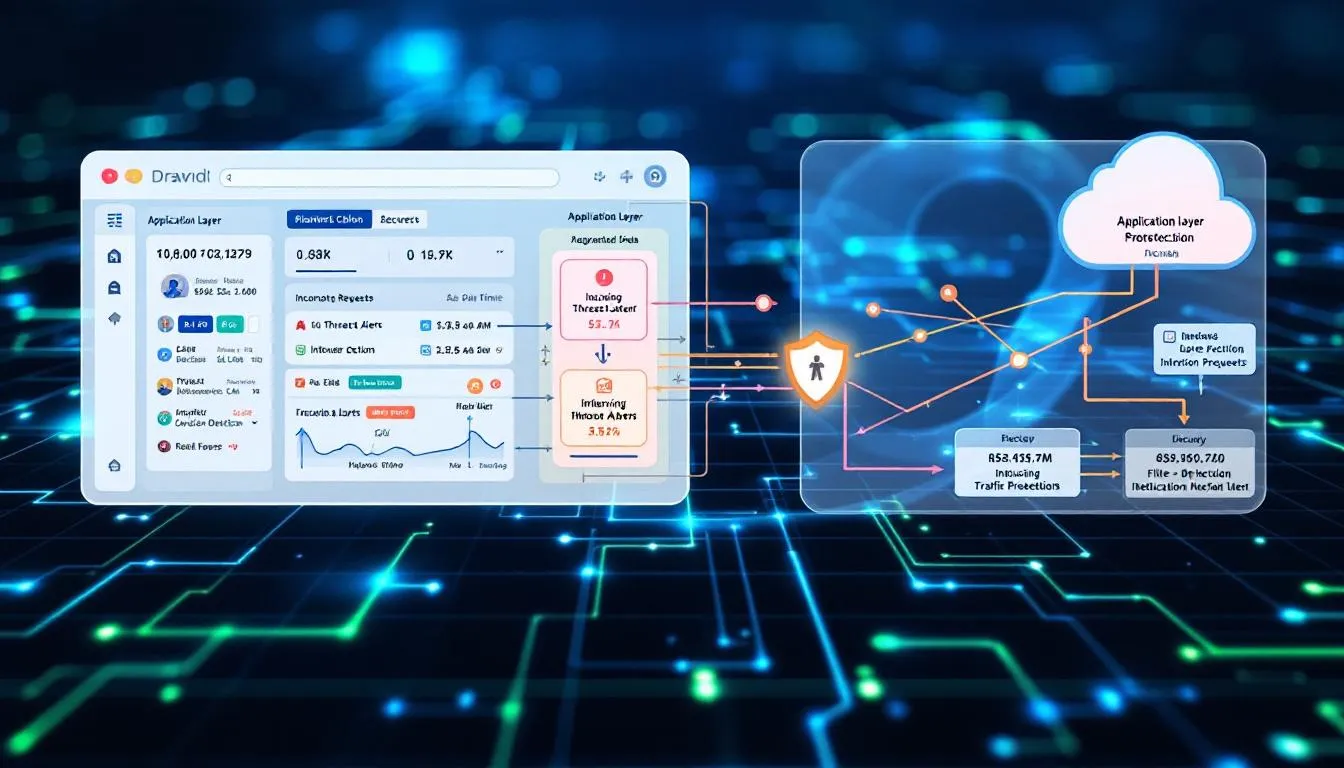
- Web application firewall protection: Provides essential defense through behavioral analysis and bot detection.
- Advanced bot detection techniques: Examine JavaScript execution, mouse movements, keyboard patterns, and browser fingerprints to distinguish between human users and automated attack scripts.
DDoS Blocking Methods and Technologies
Network-Level Protection
Network-level protection operates at OSI layers 3 and 4, providing comprehensive defense against protocol attacks and volumetric floods. This protection uses BGP routing and GRE encapsulation for seamless traffic redirection to scrubbing centers without requiring changes to existing network infrastructure.
- Magic Transit services: Offer network DDoS protection specifically designed for data centers and enterprise infrastructure defense.
- Protocol support: These services support multiple protocols including TCP, UDP, IPSec, and VoIP traffic.
Example: BGP Routing Configuration for Traffic Scrubbing
BGP routing configuration for traffic scrubbing
router bgp 65001 network 203.0.113.0/24 neighbor 198.51.100.1 remote-as 65002 neighbor 198.51.100.1 route-map SCRUBBING-OUT out
route-map SCRUBBING-OUT permit 10 set community 65002:666 # Trigger scrubbing
Application-Level Protection
Application-level protection focuses on web applications and provides sophisticated analysis of HTTP/HTTPS traffic patterns. This protection integrates with existing website infrastructure through DNS configuration changes or CDN services, offering unlimited mitigation capacity for application-specific attacks.
- Website DDoS protection: Includes content delivery network acceleration, SSL/TLS termination, and performance optimization alongside security features.
- Spectrum services: Provide TCP/UDP application protection using pay-as-you-go pricing models that scale with legitimate traffic volumes.
Key Features
- Real-time traffic scrubbing with <3 second response times
- Custom filtering rules based on IP reputation and geographic location
- Integration with web application firewalls for comprehensive application layer protection
- Automated attack notifications and detailed analytics dashboards
Cloud-Based Solutions
Cloud providers offer scalable DDoS protection through global filtering networks with massive capacity and geographic distribution. These solutions provide 10-minute activation times and professional support with 15-minute response guarantees for critical incidents.
- Infrastructure: Typically spans 330+ worldwide locations with combined capacity exceeding 5 Tbps.
- Distributed architecture: Ensures that attack traffic is filtered close to its source, minimizing impact on global internet infrastructure.
Example: API-Based Protection Configuration
API-based protection configuration
curl -X POST “https://api.example.com/zones/ZONE_ID/settings/ddos”
-H “Authorization: Bearer TOKEN”
-H “Content-Type: application/json”
-d ‘{“value”: “on”, “sensitivity”: “high”}’
- Real-time analytics and customizable filtering rules enable fine-tuning protection parameters based on specific traffic patterns and business requirements.
- Integration with existing security tools and SIEM systems provides comprehensive visibility into attack patterns and mitigation effectiveness.
Global Network Protection
Global DDoS protection requires distributed scrubbing infrastructure to handle attack traffic before it hits your origin servers. Single-point defenses fail against modern volumetric attacks that exceed 100 Gbps. We deploy scrubbing centers across multiple regions with BGP anycast routing to absorb attack traffic close to the source.
Example: Checking Current Attack Traffic Patterns
Check current attack traffic patterns
curl -s “https://api.cloudflare.com/client/v4/zones/$ZONE_ID/analytics/dashboard
-H “Authorization: Bearer $CF_API_TOKEN” |
jq ‘.result.timeseries[].requests.threat’
- Automatic traffic rerouting: When attack signatures trigger, WAF rules detect volumetric floods, then BGP announcements redirect traffic through scrubbing centers.
- Rate limiting: Kicks in at 1000 requests per minute per IP, but legitimate traffic flows through unchanged.
Example: Cloudflare Rate Limiting Rule
Cloudflare rate limiting rule
curl -X POST “https://api.cloudflare.com/client/v4/zones/$ZONE_ID/rate_limits”
-H “Authorization: Bearer $CF_API_TOKEN”
-H “Content-Type: application/json”
-d ‘{ “match”: {“request”: {“url”: “*”}}, “threshold”: 1000, “period”: 60, “action”: {“mode”: “challenge”} }’
- GeoIP blocking: Used for obvious attack sources and challenge suspect traffic with CAPTCHAs.
- Downside: Legitimate users from blocked regions cannot access your services. Plan fallbacks for critical business regions.
Example: Typical Attack Log During Mitigation
Typical attack log during mitigation
2025-01-15 14:23:12 WARN: Rate limit exceeded for 192.168.1.100 2025-01-15 14:23:15 INFO: Challenge served to 203.0.113.45 2025-01-15 14:23:18 BLOCK: GeoIP China blocked (attack pattern detected)
- Always-on protection: Requires careful tuning to avoid blocking legitimate traffic.
- Monitoring: Set up monitoring for false positives and keep emergency bypass rules ready.
- Health checks: Configure health checks every 30 seconds to verify origin server availability during attacks.
Example: Health Check with Fallback
Health check with fallback
curl -f -m 5 https://your-app.com/health ||
curl -f -m 5 https://backup-app.com/health
Emergency bypass (use sparingly)
curl -X POST “https://api.cloudflare.com/client/v4/zones/$ZONE_ID/rate_limits/$RULE_ID”
-H “Authorization: Bearer $CF_API_TOKEN”
-d ‘{“disabled”: true}’
- Ongoing tuning and monitoring: Start with conservative rate limits and gradually tighten based on attack patterns.
- BGP announcements: Keep updated and test failover procedures monthly.
Example: Verifying Current Protection Status
Next step: verify your current protection status
dig +short your-domain.com | head -1 curl -sI https://your-domain.com | grep -E ‘server|cf-ray’
Best Practices for DDoS Blocking
Establishing Baselines
- Monitor normal traffic patterns during different time periods, including peak business hours, seasonal variations, and special events.
- Document typical request rates, geographic distribution, and protocol usage to create accurate detection thresholds.
Response Planning
- Create comprehensive DDoS response plans with clear mitigation procedures and escalation protocols.
- Include contact information for cloud providers, internal security teams, and external incident response services.
- Define specific triggers for activating different protection levels and establish communication procedures for business stakeholders.
Infrastructure Resilience
- Build resilient infrastructure using distributed data centers, redundant DNS servers, and multiple traffic filtering tools.
- Implement geographic load balancing to distribute traffic across multiple regions, reducing the impact of localized attacks.
- Ensure that critical business applications have redundant hosting arrangements and can failover between providers.
Continuous Monitoring
- Implement continuous monitoring with threat intelligence integration and geo-blocking capabilities.
- Configure automated alerts for unusual traffic patterns, connection anomalies, and performance degradation.
- Integrate with security information and event management (SIEM) systems to correlate DDoS activity with other security events.
Employee Training
- Regular security training for employees helps prevent social engineering attacks that often precede DDoS incidents.
- Training should cover recognizing suspicious communications and proper incident response procedures.
Additional Security Measures
- Implement rate limiting on all public-facing services.
- Use web application firewalls with updated rule sets.
- Deploy intrusion detection systems with DDoS-specific signatures.
- Establish relationships with internet service providers for traffic filtering.
- Conduct regular penetration testing and DDoS simulation exercises.

DDoS Blocking Service Providers
- Cloudflare: Offers free CDN and DDoS protection starting at $0 with unlimited unmetered mitigation for websites. Their network spans over 200 cities worldwide, providing comprehensive protection against volumetric attacks, protocol attacks, and application layer threats. Enterprise plans include advanced features like custom rule creation, detailed analytics, and priority support.
- StormWall: Provides enterprise protection with sub-account management and pay-per-legitimate-traffic pricing models. Their services include specialized protection for e-commerce platforms, gaming servers, and financial services with customized filtering rules and dedicated account management.
- Specialized DDoS-as-a-Service providers: Offer scalable resources and professional mitigation expertise for organizations requiring maximum protection levels. These services typically include:
- Dedicated scrubbing centers with guaranteed capacity
- 24/7 security operations center monitoring
- Custom attack mitigation strategies
- White-glove support with direct engineer access
- Service level agreements with uptime guarantees
When selecting providers, evaluate their network capacity, global presence, response times, and integration capabilities with your existing infrastructure. Consider both the technical capabilities and the support model to ensure appropriate coverage for your business requirements.
Implementation and Setup
Implementation begins with easy dashboard and API-based configuration for quick deployment and traffic management. Most cloud providers offer web interfaces that guide you through the setup process, including DNS configuration changes and initial protection rule creation.
DNS Configuration
- Update your domain’s DNS records to point to the protection service’s endpoints, enabling traffic filtering before requests reach your origin servers.
Example: DNS Configuration
DNS configuration example
www.example.com. 300 IN A 203.0.113.10 # Protection service IP api.example.com. 300 IN CNAME api.protection-service.com.
BGP Routing Setup
- BGP routing setup provides network-level protection by advertising your IP space through the protection provider’s network. This approach requires coordination with your internet service provider.
Example: BGP Announcement Configuration
BGP announcement configuration
router bgp 65001 network 203.0.113.0/24 neighbor 198.51.100.1 remote-as 65002 neighbor 198.51.100.1 prefix-list ANNOUNCE-PREFIXES out
ip prefix-list ANNOUNCE-PREFIXES permit 203.0.113.0/24
Integration Testing
- Verify that all legitimate traffic flows correctly through the protection service.
- Test geographic access from different regions.
- Confirm that performance remains acceptable under various load conditions.
Performance Monitoring
- Monitor key metrics including:
- Time to first byte (TTFB) for web applications
- Connection establishment times for TCP services
- DNS resolution performance from multiple locations
- Cache hit rates for static content delivery
- Error rates and timeout frequencies
- Establish baseline measurements before activation and continuously monitor these metrics to identify any performance impacts from protection services.
FAQ
How quickly can DDoS blocking services respond to an attack?
Modern DDoS protection services can mitigate most attacks in under 3 seconds using automated detection and response systems. The fastest services use always-on protection that analyzes all incoming traffic continuously, enabling immediate response without human intervention. Advanced providers offer 15-minute support response times for manual intervention when automated systems require additional configuration or when dealing with sophisticated application layer attacks that may need custom mitigation rules.
What’s the difference between free and paid DDoS blocking services?
Free services typically cover basic website protection for HTTP/HTTPS traffic with standard mitigation against common volumetric attacks and simple application layer threats. These services work well for small websites and blogs but have limitations on customization and support. Paid services offer advanced features like TCP/UDP application protection, custom filtering rules, detailed real time analytics, geographic blocking capabilities, and dedicated support teams for enterprise environments. Enterprise plans also include higher SLA guarantees and integration with existing security infrastructure.
Can DDoS blocking affect legitimate website performance?
Properly configured DDoS blocking services actually improve performance by filtering malicious traffic and often include content delivery network acceleration that brings content closer to users. However, overly aggressive filtering rules can occasionally impact legitimate users, particularly when geographic blocking is too broad or rate limiting thresholds are set too low. This is why baseline traffic analysis is essential before implementation, and why protection services offer monitoring tools to track both security effectiveness and user experience metrics.
Do I need different DDoS blocking for different types of applications?
Yes, different applications require specialized protection approaches. Web applications need HTTP/HTTPS protection with web application firewall capabilities, gaming servers require UDP protection with low-latency filtering, and enterprise networks need comprehensive Layer 3/4 protection covering multiple protocols. Email servers, VoIP systems, and streaming services each have unique traffic patterns that require customized protection rules. Many providers offer tiered services covering multiple application types, but the configuration and filtering rules must be tailored to each specific use case.
How much bandwidth capacity is needed to block large DDoS attacks?
Major DDoS attacks can exceed several terabits per second, with the largest recorded attacks reaching 449 Tbps in scale. Individual organizations typically cannot build infrastructure capable of handling such massive attack volumes cost-effectively. This is why most businesses rely on cloud-based services with global networks that maintain hundreds of terabits of combined filtering capacity across multiple data centers and scrubbing centers. The distributed nature of these networks ensures that even massive attacks can be absorbed and filtered without impacting the target organization’s infrastructure or other services.






