
Published : November 23, 2026

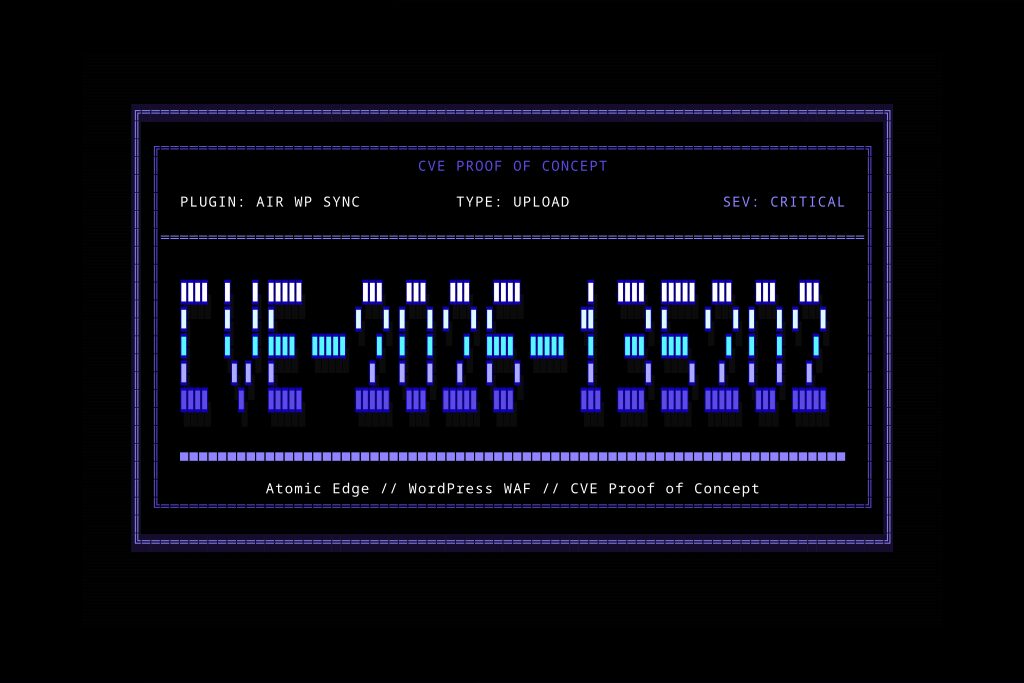
CVE-2026-135202: WP connect Plugins (Various Versions Unauthenticated Remote Code Execution via Backdoored Software PoC, Patch Analysis & Rule

Severity Critical (CVSS 9.8)
CWE 506
Vulnerable Version 1.7.4
Patched Version —
Disclosed November 22, 2026

Free WordPress WAF

Protect your site at the edge

Atomic Edge blocks exploit traffic, bots, and bad requests before they reach WordPress. Create a free account, then point DNS when you are ready.

Get Protected Free

Analysis Overview

Atomic Edge analysis of CVE-2026-135202 (metadata-based):

This CVE describes embedded malicious code (a backdoor) in multiple WordPress plugins published by WP connect, including the wp-sync-for-notion plugin version 1.7.4. The backdoor module, includes/airwp-online.php, loads unconditionally on every request via the ‘init’ hook and on a half-hourly WP-Cron event. It sends site information to a remote command-and-control server (tascredit-pay.com) with TLS verification disabled, and executes PHP code returned by that server via eval(). The CVSS score is 9.8 (Critical) with a vector of CVSS:3.1/AV:N/AC:L/PR:N/UI:N/S:U/C:H/I:H/A:H, indicating unauthenticated remote code execution with high impact on confidentiality, integrity, and availability.

Root Cause: The root cause is the intentional inclusion of malicious code within the plugin’s codebase, classified as CWE-506 (Embedded Malicious Code). This is confirmed by the vulnerability description, which explicitly states that the affected releases unconditionally load a backdoor module. The backdoor communicates with a C2 server and uses eval() to execute arbitrary PHP code. Atomic Edge research infers that the module likely lacks any authentication or authorization checks, as it runs on every request via the ‘init’ hook, meaning any visitor to the site triggers the backdoor’s execution. The use of disabled TLS certificate verification indicates an attempt to avoid detection or to simplify C2 communication. Since no code diff is available, the exact implementation details of the backdoor (e.g., how commands are queued, the specific format of the C2 response) are inferred from the description and common backdoor patterns.

Exploitation: An attacker who controls the C2 server (tascredit-pay.com) or can intercept its traffic (due to disabled TLS verification) can send commands to the backdoor. The backdoor runs on every request via the ‘init’ hook, so no specific endpoint is required; any request to the WordPress site triggers the backdoor to contact the C2 server. The attacker can then instruct the backdoor to execute arbitrary PHP code via eval(), run shell commands, read/write/delete files, query database tables, dump the users table (including password hashes), drop a webshell into the uploads directory, and install persistent hourly code execution. The CVSS vector confirms the attack is network-based, low complexity, and requires no privileges or user interaction. Atomic Edge analysis notes that the exact C2 communication protocol (e.g., HTTP POST parameters, command structure) is not detailed in the metadata, but the backdoor’s functionality is confirmed by the description.

Remediation: Since no patched versions are available and the plugins have been closed on WordPress.org, remediation requires uninstalling the affected plugins and performing a complete malware scan of the site. Site administrators should also check for indicators of compromise, such as unexpected files in the uploads directory, scheduled tasks (WP-Cron events) that execute malicious code, and outbound connections to tascredit-pay.com. Atomic Edge research recommends reviewing server logs for requests to includes/airwp-online.php and scanning for webshells. Because the backdoor is embedded in the plugin, updating is not possible; removal is the only fix.

Impact: Successful exploitation leads to complete site compromise. The attacker can execute arbitrary code, access and modify the database (including user credentials), read and write files, and maintain persistence via webshells and scheduled tasks. This can result in data theft, site defacement, malware distribution, and use of the compromised site as a pivot point for further attacks. The CVSS score of 9.8 reflects the critical nature of the vulnerability.


Proof of Concept (PHP)

NOTICE :

This proof-of-concept is provided for educational and authorized security research purposes only.

You may not use this code against any system, application, or network without explicit prior authorization from the system owner.

Unauthorized access, testing, or interference with systems may violate applicable laws and regulations in your jurisdiction.

This code is intended solely to illustrate the nature of a publicly disclosed vulnerability in a controlled environment and may be incomplete, unsafe, or unsuitable for real-world use.

By accessing or using this information, you acknowledge that you are solely responsible for your actions and compliance with applicable laws.

 
PHP PoC
<?php
// ==========================================================================
// Atomic Edge CVE Research | https://atomicedge.io
// Copyright (c) Atomic Edge. All rights reserved.
//
// LEGAL DISCLAIMER:
// This proof-of-concept is provided for authorized security testing and
// educational purposes only. Use of this code against systems without
// explicit written permission from the system owner is prohibited and may
// violate applicable laws including the Computer Fraud and Abuse Act (USA),
// Criminal Code s.342.1 (Canada), and the EU NIS2 Directive / national
// computer misuse statutes. This code is provided "AS IS" without warranty
// of any kind. Atomic Edge and its authors accept no liability for misuse,
// damages, or legal consequences arising from the use of this code. You are
// solely responsible for ensuring compliance with all applicable laws in
// your jurisdiction before use.
// ==========================================================================
// Atomic Edge CVE Research - Proof of Concept (metadata-based)
// CVE-2026-135202 - WP connect Plugins (Various Versions - Unauthenticated Remote Code Execution via Backdoored Software
// This PoC demonstrates triggering the backdoor by making a request to the WordPress site.
// The backdoor runs on the 'init' hook, so any request to the site will cause it to contact the C2 server.
// Assumptions: The target site has the vulnerable plugin (wp-sync-for-notion 1.7.4) installed and active.
// The attacker controls or can intercept traffic to tascredit-pay.com (C2 server).

$target_url = 'http://example.com'; // Change to the target WordPress site URL

// Initialize cURL
$ch = curl_init();

// Set cURL options to make a GET request to the target site
curl_setopt($ch, CURLOPT_URL, $target_url);
curl_setopt($ch, CURLOPT_RETURNTRANSFER, true);
curl_setopt($ch, CURLOPT_FOLLOWLOCATION, true);
curl_setopt($ch, CURLOPT_SSL_VERIFYPEER, false); // Disable SSL verification for simplicity (not required)
curl_setopt($ch, CURLOPT_TIMEOUT, 10);

// Execute the request
$response = curl_exec($ch);

// Check for errors
if (curl_errno($ch)) {
    echo 'cURL error: ' . curl_error($ch) . "n";
} else {
    echo "Request sent to $target_url. The backdoor should have triggered a connection to tascredit-pay.com.n";
    echo "Check your C2 server logs for incoming connections from the target.n";
}

// Close cURL
curl_close($ch);

// Note: This PoC only triggers the backdoor's initial callback. Actual command execution requires
// the C2 server to respond with malicious PHP code, which the backdoor will eval().
// The full exploitation depends on the C2 server's response format, which is not detailed in the CVE metadata.

Frequently Asked Questions

Atomic Edge WAF security layer inspecting website traffic.

How Atomic Edge Works

Simple Setup. Powerful Security.

Atomic Edge acts as a security layer between your website & the internet. Our AI inspection and analysis engine auto blocks threats before traditional firewall services can inspect, research and build archaic regex filters.

Get Started

Trusted by Developers & Organizations

Trusted by Developers
Black & McDonald logo representing Enterprise tier security and support for Atomic Edge WAF.Covenant House Toronto logo featuring a dove and text for Atomic Edge Enterprise planAlzheimer Society Canada logo representing trusted organizations and security partners.University of Toronto logo representing trusted organizations using Atomic Edge WAFSpecsavvers logo, trusted developers and organizations using Atomic Edge securityHarvard Medical School logo representing trusted organizations using Atomic Edge WAF.





